Our friends at Wal-Mart Watch have done great research on this issue here is their releaseAdditional information on Wal-Mart's health care plan is available below and at www.walmartwatch.com/healthcare.
WAL-MART'S HEALTH CARE PLAN: RHETORIC VS. REALITY
RHETORIC: Wal-Mart says it does offer affordable health-insurance coverage for its workers.
REALITY: But Wal-Mart knows that coverage is too expensive for its workforce. A memo written by Susan Chambers, Wal-Mart Executive Vice-President for Benefits, for the Wal-Mart board of directors, said: "[O]ur critics are correct in some of their observations. Specifically, our coverage is expensive for low-income families, and Wal-Mart has a significant percentage of associates and their children on public assistance." [Susan Chambers Memo to the Wal-Mart Board of Directors, http://walmartwatch.com/memo; New York Times, 10/26/05]
RHETORIC: Wal-Mart says it offers health care plans with low premiums.
REALITY: But according to the Center for a Changing Workforce, in 2003 Wal-Mart employees paid 41 percent of insurance premium costs. At the time of the report, Costco employees paid about 10 percent of premium costs. Nationally, workers today pay an average of 16 percent of premiums for single coverage and 26 percent for family coverage. [Employer Health Benefits 2005 Annual Survey, The Kaiser Family Foundation and Health Research and Educational Trust; Wal-Mart and Healthcare: Condition Critical, Center for a Changing Workforce, 10/26/05]
RHETORIC: Wal-Mart says its employees are only slightly more likely to collect Medicaid than average.
REALITY: However, the Susan Chambers memo recognizes that "five percent of our associates are on Medicaid compared to an average for national employers of four percent. Twenty-seven percent of associates' children are on such programs, compared to a national average of twenty-two percent." [Susan Chambers Memo to the Wal-Mart Board of Directors, http://walmartwatch.com/memo; New York Times, 10/26/05]
RHETORIC: Wal-Mart says it is among a small number of retail employers to offer health coverage to both part-time and full-time employees.
REALITY: But the percentage of associates covered by Wal-Mart health insurance in January 2006 was 46 percent, compared to a national average of 67 percent of workers for large firms who receive health benefits from their employers. [http://www.walmartfacts.com; Employer Health Benefits 2005 Annual Survey, The Kaiser Family Foundation and Health Research and Educational Trust]
RHETORIC: Wal-Mart will claim it has more full-time workers than other retailers.
REALITY: But the company's part-time workforce - currently around 20 percent of the company's employees - is larger than the national retail average. Furthermore, Wal-Mart executives have acknowledged that the retailer will shift to a heavier reliance on part-time workers. A recent JP Morgan report said Wal-Mart plans to increase the ratio of its 1.2 million-member U.S. hourly workforce on part-time schedules to 40 percent from 20 percent. Citigroup analyst Deborah Weinswig predicted that Wal-Mart's proportion of full-time workers is declining, and in a 60-page research report, she predicted that "Wal-Mart will reduce its ratio of full-time workers to 60 percent over the next year or so, with the remaining 40 percent slated for part-time status." [Wall Street Journal, 4/11/06; Associated Press, 5/3/06]
RHETORIC: Wal-Mart claims it shortened the waiting period for part-time workers to receive health coverage by half.
REALITY: But Wal-Mart has more part-time workers, which lowers the number of employees who are eligible for coverage. Wal-Mart's part-time workforce is larger than the national retail average. Full-time Wal-Mart employees still wait twice as long for health care eligibility compared to the average for the retail industry. Wall Street Journal, 4/11/06; Associated Press, 5/3/06; Employer Health Benefits 2005 Annual Survey, The Kaiser Family Foundation and Health Research and Educational Trust]
Time will tell what this "new" health care plan really becomes, until then we must continue to fight for better working conditions at Wal-Mart.
Thursday, September 21, 2006
Health Care


Tuesday, September 19, 2006
Wal-Mart Ends Layaway Program
Yet another way Wal-Mart is only looking out for themselves, by doing away with this program Wal-Mart hopes that more customers will apply for a Wal-Mart Credit Card. Wal-Mart also still continues to push for a bank.
Monday, September 18, 2006
Chicago's Big Box legislation gets the boot
The ground breaking legislation was passed earlier this year, but then vetoed by Mayor Richard Daley. And since Mayor Daley vetoed the big box ordinance, WalMart representatives are reportedly planning on building even more. A report in Crain's Chicago Business stated Saturday that WalMart stores have decided to move forward with plans of building five new Chicago area stores, and may eventually want as many as 20 stores.
Wal-Mart to launch first celebrity home decor line
CHICAGO (Reuters) - Wal-Mart Stores Inc. on Thursday said it planned to launch its first line of holiday home decor by designer Colin Cowie, joining a long list of retailers turning to celebrities for exclusive merchandise.
The world's biggest retailer said the collection would include barware, photo frames, dinnerware and table linens, with prices ranging from $2.94 for a champagne flute to $39.97 for a floral topiary. It will be available in October.
Colin Cowie is a celebrity event and wedding planner who has appeared on television programs that include "The Oprah Winfrey Show" and the "CBS Early Show."
Wal-Mart has been adding upscale merchandise as it tries to get wealthier shoppers to buy more high-margin goods. The retailer recently launched advertising campaigns highlighting its plasma televisions and trendier clothing.
Wednesday, September 13, 2006
Wal-Mart Speaks Out Against Democratic Critics
Wal-Mart has announced that it is sending letters to its 18,000 Iowa employees and also to the Democratic politicians defending itself from attacks of union-backed group "Wake Up Wal-Mart" after a series of rallies in Iowa this week.
The letter so-called "Voter Education Guide" denounces the presidential hopefuls for joining the campaign-style events.
In the letter released Tuesday the retailer said, "We believe it's wrong for these political candidates to attack Wal-Mart and the transformation under way at our company."
"We would never suggest to you how to vote, but we have an obligation to tell you when politicians are saying something about your company that isn't true," it said.
The group has been pressurizing Wal-Mart to provide higher wages and better health care to its 1.3 million U.S. employees. The group also charges the retailer of shifting U.S. jobs overseas by selling low-priced imports.
In letters to potential Democratic presidential candidates and party leaders, Wal-Mart invited them to meet with the company "without the fanfare of media or staff or supporters.
"We don't want this to be about politics - the union-funded groups are already doing enough of that for the both of us," the letter said.
The company's letter to its Iowa employees said it is important that they help it respond to criticism.
"We want you to know that your voice matters when these political candidates attack your company. We urge you to talk with your friends, your family and your neighbors about the good Wal-Mart does," the letter said.
A press release by the Bentonville, Ark.-based Company said that polling data shows voters do not agree with attacks on Wal-Mart by candidates.
According to the release, 62 percent of those surveyed by Democratic pollster Thomas Riehle for the Cook Political Report disapprove of "Democratic candidates making Wal-Mart an issue in November's elections," while only 21 percent approve.
Even a majority of union households opposed this strategy, according to the company.
Overall, 40 percent of registered voters would vote against an anti-Wal-Mart Democratic candidate, while just 18 percent would vote for such a candidate, the company's statement said.
Wal-Mart's letter to its employees says that published schedules show U.S. Sens. Evan Bayh of Indiana and Joseph Biden of Delaware, and Govs. Bill Richardson of New Mexico and Tom Vilsack of Iowa are taking part in the rallies against the company.
However, the letter made no mention about Sen. Hillary Clinton of New York, who the Wake-Up Wal-Mart site said has also joined the group in criticism of the company.
Monday, September 11, 2006
Wal-Mart's political Allies
Wal-Mart Finds an Ally in Conservatives
As Wal-Mart Stores struggles to rebut criticism from unions and Democratic leaders, the company has discovered a reliable ally: prominent conservative research groups like the American  Enterprise Institute, the Heritage Foundation and the Manhattan Institute.
Top policy analysts at these groups have written newspaper opinion pieces around the country supporting Wal-Mart, defended the company in interviews with reporters and testified on its behalf before government committees in Washington.
But the groups — and their employees — have consistently failed to disclose a tie to the giant discount retailer: financing from the Walton Family Foundation, which is run by the Wal-Mart founder Sam Walton’s three children, who have a controlling stake in the company.
The groups said the donations from the foundation have no influence over their research, which is deliberately kept separate from their fund-raising activities. What’s more, the pro-business philosophies of these groups often dovetail with the interests of Wal-Mart.
But the financing, which totaled more than $2.5 million over the last six years, according to data compiled by GuideStar, a research organization, raises questions about what the research groups should disclose to newspaper editors, reporters or government officials. The Walton Family Foundation must disclose its annual donations in forms filed with the Internal Revenue Service, but research groups are under no such obligation.
Companies and such groups have long courted one another — one seeking influence, the other donations — and liberal policy groups receive significant financing from unions and left-leaning organizations without disclosing their financing.
But the Walton donations could prove risky for Wal-Mart, given its escalating public relations campaign. The company’s quiet outreach to bloggers, beginning last year, touched off a debate about what online writers should disclose to readers, and its financing to policy groups could do the same.
Asked about the donations yesterday, Mona Williams, a spokeswoman for Wal-Mart, said, “The fact is that editorial pages and prominent columnists of all stripes write favorably about our company because they recognize the value we provide to working families, the job opportunities we create and the contributions we make to the community we serve.”
At least five research and advocacy groups that have received Walton Family Foundation donations are vocal advocates of the company.
The American Enterprise Institute for Public Policy Research, for example, has received more than $100,000 from the foundation in the last three years, a fraction of the more than $24 million it raised in 2004 alone.
Richard Vedder, a visiting scholar at the institute, wrote an opinion article for The Washington Times last month, extolling Wal-Mart’s benefits to the American economy. “There is enormous economic evidence that Wal-Mart has helped poor and middle-class consumers, in fact more than anyone else,” Mr. Vedder wrote in the article, which prominently identified his ties to institute.
But neither Mr. Vedder nor the newspaper mentioned American Enterprise Institute’s financial links to the Waltons. Mr. Vedder, a professor at Ohio University, said he might have disclosed the relationship had the American Enterprise Institute told him of it. “I always assumed that A.E.I. had no relationship or a modest, distant relationship with the company,” said Mr. Vedder, who has written a forthcoming book about the company. The book, he said in an interview yesterday, would eventually contain a disclosure about the Walton donations to the institute.
A spokesman for the Walton Family Foundation, Jay Allen, said there was no organized campaign to build support for Wal-Mart among research groups. All of the foundation’s giving, he said, is directed toward a handful of philanthropic issues, including school reform, the environment and the economy in Northwest Arkansas, where Wal-Mart is based. “That is the spirit and purpose of their giving,” Mr. Allen said.
Mr. Allen said the foundation, which had assets of $608.7 million in 2004, the last year for which data is available, has never asked the research groups to disclose the donations because “the family leaves it up to the individual organization to decide.”
Those groups, for the most part, say they have decided not to share the information with their analysts or the public.
For example, Sally C. Pipes, the president of the Pacific Research Institute, a free-market policy advocate, has written several opinion articles defending Wal-Mart in The Miami Herald and The San Francisco Examiner.
A month after a federal judge in California certified a sex discrimination lawsuit against the company as a class action in 2004, Ms. Pipes wrote an article in The Examiner criticizing the lawyers and the women behind the suit. “The case against Wal-Mart,” she wrote, “follows the standard feminist stereotype of women as victims, men as villains and large corporations as inherently evil.”
The article did not disclose that the Walton Family Foundation gave Pacific Research $175,000 from 1999 to 2004. Ms. Pipes was aware of the contributions, but said the money was earmarked for an education reform project and did not influence her thinking about the lawsuit. Asked why she typically did not disclose the donations to newspapers, she said: “It never occurs to me to put that out front unless I am asked. If newspapers ask, I am completely open about it.”
The lack of disclosure highlights the absence of a consistent policy at the nation’s newspapers about whether contributors must tell editors of potential conflicts of interest.
Juan M. Vasquez, the deputy editorial page editor of The Miami Herald, which ran an opinion article praising Wal-Mart by Ms. Pipes of Pacific Research, said his staff researches organizations that write opinion articles, including their financing. But that does not always require asking if the organization has received money from the subject of an article, he said.
The New York Times has a policy of asking outside contributors to disclose any potential conflicts of interest, including the financing for research groups.
Several of the research groups noted that their mission is to be an advocate for free market policies and less government intrusion in business. “Those aims are pro-business, so it’s not surprising that companies would be supporters of our work,” said Khristine Brookes, a spokeswoman for the Heritage Foundation.
Last year, for instance, The Baltimore Sun published an op-ed article by Tim Kane, a research fellow at Heritage, in which he criticized Maryland’s efforts to require Wal-Mart to spend more on health care. He objected to the move on the grounds that it was undue government interference in the free market, a traditional concern of Heritage.
“The existence of Wal-Mart dented the rise in overall inflation so much that Jerry Hausman, an economist from the Massachusetts Institute of Technology, is calling on the federal government to change the way it measures prices,” Mr. Kane wrote. “Translation: Wal-Mart is fighting poverty faster than government accountants can keep track.”
Ms. Brookes pointed out that the $20,000 Heritage has received from the Walton Family Foundation since 2000 amounts to less than 1 percent of its $40 million budget.
Ms. Brookes said it was unlikely that researchers and analysts at Heritage were even aware of the foundation’s contributions. “Nobody here would know that unless they walked upstairs and asked someone in development,” she said. “It’s just never discussed.”
She said Heritage did not accept money for specific research. “The money from the Walton Family Foundation has always been earmarked for our general operations,” she said. “They’ve never given us any funds saying do this paper or that paper.”
A spokeswoman for the American Enterprise Institute said the group did not comment on its donors. The group’s focus on Wal-Mart has been notable. In June, the editor in chief then of the group’s magazine, The American Enterprise, wrote a long essay defending Wal-Mart against critics. The editor, Karl Zinsmeister, now the chief domestic policy adviser at the White House, said the campaign against the company was “run by a clutch of political hacks.”
Conservative groups are not the only ones weighing in on the Wal-Mart debate. Ms. Williams of Wal-Mart noted labor unions have financed organizations that have been critical of Wal-Mart, like the Economic Policy Institute, which received $2.5 million from unions in 2005.
In response, Chris Kofinis, communications director for WakeUpWalmart.com, an arm of the United Food and Commercial Workers Union that gives money to liberal research groups, said: "While we openly support the mission of economic justice, Wal-Mart and the Waltons put on a smiley face, hide the truth, all while supporting right-wing causes who are paid to defend Wal-Mart’s exploitative practices.”
The lack of a clear quid pro quo between research groups and corporations like Wal-Mart makes the issue murky, said Diana Aviv, chief executive of the Independent Sector, a trade organization representing nonprofits and foundations. “I don’t know how one proves what’s the chicken and what’s the egg,” she said.
Last year, the National Committee for Responsive Philanthropy, a research and watchdog group, published a report, “The Waltons and Wal-Mart: Self-Interested Philanthropy,” that warned of the potential influence their vast wealth gives them.
But Rick Cohen, executive director of the group, said he was more concerned about the role the Walton foundation’s money might play in shaping public policy in areas like public education, where it has supported charter schools and voucher systems.
“These are certainly not organizations created and controlled by the corporation or the family and promoted as somehow authentic when they aren’t,” Mr. Cohen said. “More important, I think, is the disclosure of the funding in whatever’s written, a sort of disclaimer.”
Friday, September 08, 2006
Wal-Mart's Gay Alliance isn't fooling anyone
Here is the AP Story of the Alliance...
WASHINGTON — Wal-Mart Stores Inc., the retail giant that grew up in the rural South, is moving to attract gay shoppers as it expands its presence in urban centers.
By entering into a partnership with the National Gay and Lesbian Chamber of Commerce this week, the company "is making a very sincere effort to reach out to people who are a significant part of our customer base," Wal-Mart spokesman Bob McAdam said Wednesday.
"I am proud of that effort," he said.
But Wal-Mart did not issue a news release about the alliance, leaving the chamber to announce it. And as news of the partnership trickles out, a backlash is taking shape among some conservatives.
"I don't think this is something that will sell on Main Street America, where most Wal-Mart stores are located," said Tony Perkins, president of the Family Research Council, a conservative public policy group in Washington. "I don't think cheap prices on goods from China will be enough to stop a rollback in their customer base if they choose to go down this aisle."
By partnering with a gay business group, Wal-Mart is "validating the idea that homosexual activists have the right to shake down corporations out of fear of being called bigots," said Robert Knight, director of the Culture and Family Institute at Concerned Women for America, a Washington-based public policy group.
In April, the retailer announced a strategy to increase its presence in urban areas. Over the next two years, it plans to build more than 50 stores in neighborhoods with high crime or unemployment rates, on sites that are environmentally contaminated, or in vacant buildings or malls in need of revitalization.
The alliance with the business group is not expected to bring a visible influx of gay-oriented merchandise to Wal-Mart stores. McAdam said the specific purpose of the partnership is to help Wal-Mart attract and hire a diverse array of suppliers, including gays and lesbians.
Though it obtains much of its merchandise from overseas suppliers, the world's largest retailer also uses many local firms to provide services, such as landscaping, architectural designing, painting and much more, he said.
Justin Nelson, co-founder and president of the four-year-old gay business coalition, said he was certain that objections from conservatives would not cause Wal-Mart, headquartered in Bentonville, Ark., to back away from his organization.
Wal-Mart initiated the partnership, he said, and "it's a rock-solid relationship."
In recent months, as his group and Wal-Mart have discussed their possible relationship, "it was brought up that religious zealots would ... make these hateful comments," he said. Wal-Mart executives persuaded chamber officials they would remain resolute, he said.
Nelson said that while Wal-Mart may start taking flak from the right, he expects it from the left.
Many liberal groups say the company fails to provide its 1.3 million U.S. workers with adequate wages and benefits.
Jeremy Bishop, program director of Pride at Work, a constituency group within the AFL-CIO labor confederation, said Wal-Mart should not expect the support of gay shoppers when it does not offer domestic partnership benefits for its gay workers.
"This community is really social justice-minded," Bishop said. "It won't be fooled by this."
McAdam said Wal-Mart has an anti-discrimination policy covering sexual orientation, and is considering offering domestic partnership benefits.
Wal-Mart is evaluating its gay-related policies in discussions with groups such as the Human Rights Campaign and the Gay and Lesbian Alliance Against Defamation, he said.
Ken Pearson, chairman of PRIDE, a group for Wal-Mart's gay, lesbian, bisexual and transgendered employees, said he has found that "Wal-Mart is very fair-minded."
He said that as the company weighs domestic partnership benefits, "the officers are very willing to listen," he said. "I would not have stuck around for 10 years if I thought Wal-Mart treated employees unfairly. The needle has a ways to go, but we are making positive progress."
Wal-Mart started reaching out to gay groups in the past year, he said.
Perhaps the most visible sign came in early April when Wal-Mart began selling DVDs of "Brokeback Mountain," a movie about a love affair between two male ranchers. The company continued to sell the DVDs despite protests from some conservatives.
Also, McAdam confirmed that Wal-Mart had hired Bob Witeck, chief executive officer of Witeck-Combs Communications Inc., a Washington-based communications firm that specializes in reaching gay consumers.
Witeck was in Bentonville in mid-April when Wal-Mart held its annual two-day conference for journalists.
News of the alliance came when the chamber posted the news on its Web site and issued a press release Monday. On Tuesday, a news story appeared in the Springdale Morning News in Arkansas.
On Wednesday, Wal-Mart Watch, a union-supported group opposed to Wal-Mart's business practices, offered a link to the story on its Web site. That started generating national attention.
Andrew Grossman, Wal-Mart Watch's executive director, said he supports Wal-Mart's efforts to diversify its supplier base.
"It's a good thing for Wal-Mart to make a decision to treat more people with respect," he said. "But I question why they wanted to keep this in the closet and leave it up to the chamber to make the announcement."
Nelson said it was normal procedure for the chamber to announce a new partnership. The group works with many other large corporations, including IBM, Wells Fargo and Kodak.
Tuesday, September 05, 2006
Wednesday, August 30, 2006
Wal-Mart Janitors
As Houston Chronicle Reports, a federal district court judge in
The janitors website: http://www.walmartjanitors.com/
"Walmartopia"
 If you haven't heard of Wal-Martopia, I suggest you visit their website immediately. Walmartopia, is a new musical here in NYC for the International Fringe Festival. The musical envisions a futuristic world dominated by the big-box store. The show has been a huge hit at the Festival and continues to receive raving reviews. So we all strongly encourage you to go out and see this funny entertaining show while it is still here!
 Broadway.com's review of the show
Wal-Martopia Review Page


Tuesday, August 29, 2006
Wal-Martics
Also in daily mishap news, an Indiana Wal-Mart has been identified as the source for the small communities recent out break in Salmonella which to date has infected 84 locals.
The Indiana State Department of Health has identified a Greenwood Wal-Mart's deli and bakery as the source of a recent outbreak of salmonella.
Health officials say workers at the store who didn't have symptoms of the illness contaminated the deli and bakery products.
Friday, August 25, 2006
WMFNYC
In an unrelated story, Wal-Mart who announced it's partnership with corporate advisory council of the National Gay and Lesbian Chamber of Commerce, is recieving a lot of criticism from all sides as they attempt to re-vamp their image as the LA Times Reported.
WMFNYC
Before we write our daily Wal-Mart mishap, here are a more articles on Wal-Mart "passing" on Staten Island read the New York Times Reported or the NY Sun Report on the Staten Island "pass" or even the Daily News Report
Thursday, August 24, 2006
VICTORY!
Wal-Mart passes on Staten Island site for store
by Elisabeth ButlerAugust 23, 2006
The world's largest retailer recently passed on a deal to build a Wal-Mart at the former Lucent Technologies site in the Tottenville neighborhood.
Wal-Mart Stores Inc. has crossed another New York City location off its list of potential store sites.
The world's largest retailer announced Wednesday that it recently passed on a deal to build a Wal-Mart at the former Lucent Technologies site in the Tottenville neighborhood of Staten Island.
Rumors about Wal-Mart's interest in the location had been circulating for about a year, but the company declined to comment until now. Preparing the site to suit a 100,000-square-foot discount retailer became too burdensome, and "it is no longer suitable for a Wal-Mart Store," a Wal-Mart spokesman noted in a press release.
The company rejected another location, the former Caldor's store in Flushing, Queens, earlier this year.
Wal-Mart is continuing to search the city for a store site and is widely expected to build several locations in the outer boroughs before broaching Manhattan.
Bentonville, Ark.-based Wal-Mart, which is pushing to establish more urban stores and tap very dense populations, has been searching out a home for its first New York City store for years.
Many political and social groups have opposed Wal-Mart's entry into the city. Several tentative deals have already fallen apart.
Retail brokers expect Wal-Mart to lease an "as of right" location that would not need to be rezoned for large commercial use.
Great Job by all WMFNYC Supporters
Wednesday, August 23, 2006
A Capped Wage Career
 As we wrote earlier, workers at more than 1,200 Wal-Mart stores will see their paychecks grow by an average of six percent. And for the first time ever, the world's largest retailer has instituted wage caps on each type of job in all stores. Some workers say it's a slap in the face to long-time employees loyal to the company. Local Wal-Mart employees, who want and need to remain anonymous, say their billion dollar company is giving them the short stick.
 "When I first started they said, it's a career, you get merit raises, you get all this. Now, they're capping us and we're stuck. I have no future." Said one associate.
Wal-Mart recently instituted a restructured pay plan where employees are categorized into job levels - the levels range from grade 1 to grade 7...each grade has a pay cap.
"I don't want to, ten years down the road, be making the same amount of money. There's no incentive for us to keep working as hard as we can to serve the customers."
Wal-Mart claims employee wages were capped because more and more long-term employees were being paid too much. Wal-Mart surveyed retailers like Home Depot and found that Wal-Mart was paying their employees more than other companies, which shouldn't make any difference at all.
"There comes a time that your management team and your company have to take care of the employees, make them number one, because if we're not happy, if we don't have that morale, then we can't take care of the customers."
With the new pay scale and the recently discontinued merit raises - Wal-Mart employees say they now get one chance a year to get a raise - at their year-end evaluation where their manager decides if a raise is warranted.
"You read in the paper the Walton family walked home with billions of dollars last year and here they just keep cutting us back and cutting us back and we're the ones that make it for them."
We cannot allow these jobs to come to New York City.
Read the Business Week Report on Wal-Mart's "Raises"
Monday, August 14, 2006
Former Wal-Mart Executive Sentenced to Home Detention
The former vice chairman of Wal-Mart Stores, Thomas M. Coughlin, who pleaded guilty to stealing money, merchandise and gift cards from the retailer, was sentenced on Friday to 27 months of home confinement and five years of probation.
Mr. Coughlin, 57, once the retailer’s No. 2 executive, avoided prison time, but was also ordered to pay a $50,000 fine and about $411,000 in restitution to Wal-Mart Stores and the Internal Revenue Service.
The number 2 executive sentenced to Home Detention for stealing money merchandise etc... It's comical to think of Coughlin's home as a detention hall. If any of us were sentenced to stay his multi-million dollar estate for 27 months, I don't think we would be too upset. Add another brick in the wall of Wal-Mart's irresponsible practices.
Read the NYT Article Here
Wednesday, August 09, 2006
Wal-Mart to give 6% raise in a third of stores
Monday, August 07, 2006
Wake Up Wal-Mart Tour brings out the best in everyone
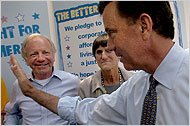 If you haven't read any of the news of Senator Lieberman and his opponent Ned Lamont speaking at the Wake Up Event in Connecticut, senate records read that Lamont actually owns Wal-Mart stock, which is very strange considering his comments on Wal-Mart "This is about waking up Wal-Mart, and this is also about waking up corporate America," This can be percieved in two ways, we give Lamont benefit of the doubt and say he does believe this movement is about changing Wal-Mart to Change America. He see's Wal-Mart's wrong doings and wants to work towards changing them. Or we can look at Lamont as a $31,000 Wal-Mart stock holder. Lamont did not mention his shareholder status with the company at the rally, but did criticize Lieberman for not doing anything during his terms in the Senate to help the workers at Wal-Mart.
You cannot help but grow weary of what this Bus Tour can become, an event for politicians to stand on their soap box preaching political promises in order to get a few more votes. This fight and struggle against Wal-Mart is about workers, it's about the workers who are mistreated time after time after time by the worlds largest company. It's about the worlds largest employer not providing health insurance to it's workers. These events cannot be a personalized soap box for politicians to showcase thier views. When Lieberman was asked if he was ready
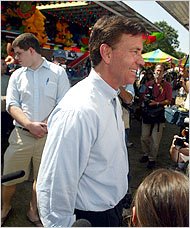 to take PAC money from Wal-Mart he quickly responded "Wal-Mart PAC sent my campaign a check in March, and we returned it a week later. Deal with the facts." (Last month WMFNYC campaigned for Congressman Vito Fossella to return Wal-Mart's $5,000 PAC, he never issued a response) Lieberman stepped up and showed his true colors by returning the money, you must question Lamont though for showing up and speaking at an Anti-Wal-Mart Rally while owning over $30,000 in Wal-Mart stock.
Thursday, August 03, 2006
Aug 1st

Signing up Supporters at Good Morning America

Democracy For America Chairman Jim Dean

WMFNYC Director Pat Purcell Speaking at Bronx Town Hall Meeting

Rev. Billy and his Chior Singing at the Bronx Town Hall

Signing up supporters on Fordham Ave.


