Tuesday, October 24, 2006

Wal-Mart at 30 Rockefeller...meet NYC

Last night 40-50 concerned community members joined at 30 Rock to tell Lee Scott he and his irresponsible company are not welcome in New York City. It was a successful night filled with chants that surely intimidated the Wal-Mart entourage. Scott, who received an environmental award last night, knows Wal-Mart is not welcome in New York(taken from Wal-Mart's fake blog www.paidcritics.com).
Our organization has brought people of all backgrounds together to fight for a common cause. We have all seen the
facts of the affect Wal-Mart has on communities, how they treat their employees, and their disrespect for labor laws. along with the help of community activists has stopped them from opening stores throughout the five boroughs. We Thank all of you for your support.
Press from yesterday's events...

NY Metro: http://ny.metro.us/metro/local/article/WalMart__MTV/5295.html
NY SUN: http://www.nysun.com/article/42161

Friday, October 20, 2006

Join us in Welcoming Lee Scott to Manhattan...


Monday October 26th

5:30 pm

30 Rockerfeller Center 49th st. Entrance

WAL - MART

Continues their Attempt to Enter Our City

Lee Scott To Be Honored

Show him Low Wages,

Increased Polution, No Benefit Jobs AREN'T WELCOME IN NYC

For More Information and to RSVP Please

Email: Walmartfreenyc@yahoo.com

Wake up Wal-Mart T-Shirts will be Distributed at the Event


Thursday, October 19, 2006

Jury: Wal-Mart to Pay Workers $78M-Plus

Wal-Mart must pay at least $78.5 million for violating Pennsylvania labor laws by forcing employees to work through rest breaks and off the clock, a jury found Friday.

Plaintiffs' lawyer Michael Donovan will also seek another $62 million in damages because the jury found that Wal-Mart acted in bad faith. Common Pleas Judge Mark Bernstein is expected to rule on that issue in the next few weeks.

The jury awarded the exact amount the plaintiffs sought, rejecting Wal-Mart's claim that some employees chose to work through breaks and that the loss of a few minutes' pay here or there was insignificant.

Reason #439 Not to let Wal-Mart in our Unique City.

Monday, October 16, 2006

Wal-Marting Across America - The Flog


Honestly, after reading countless articles and reports on the great people who run Wal-Mart and their PR department you learn to laugh at some of the ridiculous stunts they try and pull over the eyes of American people. Regardless of where we stand on Wal-Mart, their ethics and Public Relations are a joke. Whether it be hiring fake liberal politicians, creating fake organizations or establishing front groups now what is simply the icing on the cake, Fake couples and their Fake traveling stories.


It has finally been revealed that the humorus flog (fake blog), www.WalMartingAcrossAmerica.com is a flat out PR stunt.
MediaPost.com has revealed the truth about the two travelers "Jim" and "Laura". For those of you who aren't familiar with Jim and Laura, here is a quick summary on what their blog was about...

Jim and Laura are like every American couple, hard workers just simply in search of a fabulous vacation from their full-time jobs. One day Jim and Laura had a brainstorm,
"I started thinking about all the other amazing things there are to see in this vast country of ours. And then I started thinking about how Wal-Mart — one in every town, practically — lets you park overnight for free."
Great idea, couldn't have said it better myself, this is where we encounter our first problem(s), they don't exist (yet at least). Through non-stop heavy criticism from bloggers proclaiming that Jim and Laura did not exist, they now do...Wal-Mart Watch: Identity revealed.

“Laura” is now Laura St. Claire, a freelance writer. Jim is James Thresher, a professional photographer and Washington Post employee. Freelancing although, is against his contract with the Post, which has ordered him to return Wal-Mart’s money and remove his photos from the flog.

"Wal-Mart has hired fake people," says Jonathan Rees, a labor historian and associate professor at Colorado State University at Pueblo, who has also worked as a staff researcher at the AFL-CIO. In a blog posting for the Web site The Writing On the Wal, Reese published an open letter to Laura and Jim challenging them to reveal themselves and asking who paid for their RV and gas.

When the blog was first released, many bloggers immediately knew how unrealistic the blog was. There has been plenty, not surprisingly... there’s more here, here, and elsewhere.

Businessweek sums up the entire confusting soap opera here in this report - "Jim & Laura- The Real Story"

Blogging is an independent way for regular people to voice their opinions and feelings. We're fine with Wal-Mart running a blog, what we shouldn't be fine with is the integrity of their blogs. Wal-Mart trying to create this 'hip' image that it is so far from, this is yet another example of Wal-Mart's attempt to fool their consumers. Another reason why this company is extremely messed up.

"Edelman wanted to make consumers think that Wal-Mart is a hip place that you'd want to use as the anchor point for a roadtrip. The problem is it's not. And because blogging is not a control-based medium, Edelman couldn't make Wal-Mart appear to be something it's not. It rang false, and they got caught."
--Publishing 2.0


Wal-Mart Adjusts Attendance Policy - Jury awards Wal-Mart Workers 78.4 million

Wal-Mart Adjusts Attendance Policy

Critics Say Plan Is Designed
To Pare Unhealthy Workers;
1-800 Number for Sick Days
By KRIS HUDSON and KRIS MAHER

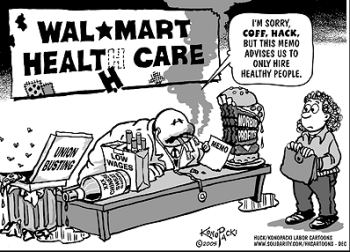
Wal-Mart Stores Inc. has enacted a new attendance policy that penalizes workers for multiple unexcused absences and requires them to call an 800 number whenever they get sick, changes critics say are part of a bigger effort to nudge out unhealthy and long-tenured employees.

Also on the labor front, a Pennsylvania jury on Friday awarded $78.4 million to thousands of Wal-Mart employees who claimed they were forced to work during rest breaks and off the clock.

Wal-Mart, of Bentonville, Ark., says the new attendance policy benefits employees by documenting their requests for time off instead of relying on harried store managers to remember each request. And it benefits shoppers by discouraging unexcused absenteeism. "It's not for tracking; it's really to ensure a more consistent application of our absentee policy," spokesman John Simley said.

The new policy instructs employees requesting time off for illness to call an 800 number to get a code and then relay that code to their store manager for approval of their absence. Previously, employees asked their store manager directly for such time off, employees say.

In addition, the new policy formalizes penalties for employees who fail to get their absences authorized or don't bother to call. Among them: Any employee with more than three unauthorized absences in a six-month span will be disciplined, and those with seven will be fired. Any employee who is absent three times during a six-month period and doesn't call the 800 number for any of the three times can be fired. And employees needing more than three consecutive sick days are encouraged to apply for an unpaid leave of absence or time off under the Family Medical Leave Act. Previously, store managers had more discretion regarding discipline for unexcused absences.

The policy change comes at a time when some of Wal-Mart's 1.3 million U.S. workers are riled by fears that the retailer wants to cut costs by attracting healthier employees and a greater percentage of part-time workers. Some employees and Wal-Mart critics decry the new policy as a way for Wal-Mart to discourage unhealthy employees by tracking sick-time use more closely, setting stricter guidelines for authorization and making the process of applying for sick leave more onerous.

"I guess they're just trying to see how many people they can get rid of," said Ramiro Gonzalez, a 49-year-old full-time worker in the produce section of a Wal-Mart in El Paso, Texas. "They're trying to make ways that you can mess it up so they can let you go, especially if you're a full-timer."

Wal-Mart's concerns about its soaring health-insurance costs came to light last year, when an internal memorandum authored by a top Wal-Mart official was leaked. The memo offered numerous suggestions for corralling benefits costs by luring healthier workers.

The new policy "just sends another terrible message that this company looks at its workers as a commodity," said Chris Kofinis, spokesman for Wal-Mart critic WakeUpWalMart.com.

From the employer perspective, automated telephone or Internet-based systems to track worker absences can protect employers against litigation related to providing adequate time off to workers under overlapping federal and state leave laws. "There are a lot of issues that surface when someone calls in sick," said Lisa Franke, a workplace analyst with CCH Inc., a Riverwoods, Ill., provider of employment-law information to companies. "It's really an administrative nightmare, so a lot of employers are outsourcing that to the experts and having them do the dirty work."

Unscheduled absences cost some large employers more than $1 million a year, according to a CCH survey of 323 human-resources executives last year. The survey found that unscheduled absenteeism cost employers $660 per employee per year on average last year, up from $610 the prior year.

In the Pennsylvania case, Wal-Mart was ordered by the jury to pay damages to nearly 187,000 current and former workers in that state. The class-action case had covered labor practices at Wal-Mart and Sam's Club stores from March 1998 through May 2006. In addition to the damages awarded by the jury, a state judge is expected to add $62 million in minimum damages required under state labor law, according to Michael Donovan, attorney for the plaintiffs in the case. That would bring total damages in the case to about $140.4 million, excluding an estimated $40 million in legal fees, he said. Wal-Mart attorney Neal Manne said he was confident the company would appeal the jury's decision.

---- Peter Loftus and James Covert contributed to this article.

Write to Kris Hudson at kris.hudson@wsj.com and Kris Maher at kris.maher@wsj.com


Friday, October 13, 2006

Weekly News Clips

Wal-Mart Comes To New York
Forbes - NY,USA
After a number of false starts, Wal-Mart Stores is planning to launch in New York City--the five boroughs, and especially the juicy, consumer-driven world of ...

Made in China: Wal-Mart Unions
YaleGlobal Online - CT,USA
... the All-China Federation of Trade Unions (ACFTU), the trade union notorious throughout the world for being “useless,” has taken on Wal-Mart and set up ...

Wal-Mart loses suit over rest breaks
Boston Globe - United States

PHILADELPHIA -- Wal-Mart broke Pennsylvania labor laws by forcing employees to work through rest breaks and off the clock, a jury decided yesterday in a ...

Wal-Mart's Too Cool for School
MSNBC - USA
By Rick Aristotle Munarriz. It's another small step back for Wal-Mart(NYSE: WMT) and a giant leap back for its not-so-hip kind. The ...

Why Wal-Mart Wants to Invade New York
Think Wal-Mart is just going to pack up its box and go home? Think again.

The Evils of Wal-Mart
ProgressiveU.org - San Mateo,CA,USA
Today my dad sent me an article from "Shopping Centers Today" about Wal-Mart's newest plan to take over the world: having different stores target different ...

Official Union in China Says All Wal-Marts Are Organized
New York Times - United States
... Mr. Guo said the labor federation would now assist workers in their negotiations with Wal-Mart management for new contracts and would seek to improve ...


Thursday, October 12, 2006

Wal-Mart Voters- The GOP-leaning retailer is encouraging employees to vote. Will that help the Democrats?

Wal-Mart Voters
The GOP-leaning retailer is encouraging employees to vote. Will that help the Democrats?
By Daniel Gross


Last Friday, Wal-Mart announced it was starting a campaign to encourage its 1.3 million associates to register to vote and participate in the electoral process. Wal-Mart is hiring politicos from the left (Charles Baker) and right (Terry Nelson) to help, and the company is providing workers with voter-registration and education materials.

Critics will assume that this is yet another attempt by Wal-Mart to stack the deck in favor of its favorite political party: the GOP. As the Center for Responsive Politics noted, Wal-Mart has given more than $1 million in federal campaign donations in this cycle, with 71 percent going to Republicans. And Wal-Mart itself is a lot like the contemporary Republican Party—strong in the South, Midwest, Sunbelt, and Great Plains, weak in the cities and coastal areas, and steadfastly hostile to organized labor. The company has also been less than subtle in letting employees know what it thinks about certain politicians. As the Financial Times noted, "In August, Wal-Mart distributed a letter to its employees in Iowa and three other states, highlighting what it said were inaccuracies in criticism by Gov. Tom Vilsack, as well as Sens. Evan Bayh of Indiana and Joseph Biden of Delaware and New Mexico's Gov. Bill Richardson." (Democrats, all.) Wal-Mart also promised employees it would "keep you informed about what these political candidates are saying about your company while on the campaign trail."

But with Wal-Mart, the politico-economic issues are never as simple as they seem, as former Kerry adviser Jason Furman has argued. It is safe to assume that most senior officers of the company are Republicans, although their numbers now include top flack Leslie Dach, a former Democratic political operative. But what about its vast army of associates? If Wal-Mart encourages them to vote and brings some marginal voters to the ballot box in the process, it could be doing Democrats a huge favor.

Wal-Mart's diversity data shows that the company's workforce, and in particular its vast army of sales associates, looks an awful lot like the Democratic base.

It is disproportionately African-American. African-Americans are about 11 percent of the American population and vote overwhelmingly for Democrats. According to this CNN exit poll, they went for Kerry by an 88-11 margin in 2004. But African-Americans constitute nearly 17 percent of Wal-Mart's employees and 18 percent of sales workers. Encouraging more middle- and lower-income African-Americans to vote in states like Arkansas, Oklahoma, and Mississippi would almost certainly be a net positive for Democratic candidates.

We know, as well, that women tend to vote disproportionately for Democrats. In 2004, according to CNN, women (and working women) voted for Kerry by a 51-48 margin. Women are substantially overrepresented in Wal-Mart's workforce. About 60 percent of all employees are women. And three-quarters of its sales workers are female—a higher proportion than at other retailers. All things being equal, more women voting will boost Democratic candidates.

Finally, Wal-Mart's workforce is disproportionately composed of lower-income workers. Barbara Ehrenreich says Wal-Mart's mean wage is $9.68 an hour, which comes out to about $20,000 a year on a full-time basis. In 2004, again according to CNN, those with incomes under $15,000 voted for John Kerry by a 63-36 margin, and those with incomes in the $15,000-$30,000 range voted for Kerry by a 57-42 margin. More lower-income Americans, many of whom are women and African-American, voting would benefit Democratic candidates.

Now, if Wal-Mart's workers all suffer from false consciousness and, a la Thomas Frank's Kansans, reliably vote against their own economic interests, then Wal-Mart's efforts to get them to the polls could help Republicans. But if the African-American, female, and low-wage workers who toil at Wal-Mart tend to vote the way other African-American, female, and low-wage workers who toil elsewhere tend to vote, then Wal-Mart's efforts will be a boon to Democrats.

Another possibility is that by encouraging employees to vote and making it clear which party it generally supports, Wal-Mart is unduly pressuring its employees to vote for Republicans. But unless Wal-Mart goons accompany associates into the ballot box, it's hard to see how that would work. Wal-Mart employees may not have been successful in organizing unions, but they don't simply take whatever the company dishes out without resisting. Lots of them show the ultimate form of resistance to pressure from their employer: Every year, about 40 percent of them quit.

Daniel Gross (www.danielgross.net) writes Slate's "Moneybox" column. You can e-mail him at moneybox@slate.com.

Article URL: http://www.slate.com/id/2151043/

Wednesday, October 11, 2006

Wal-Mart's eyes still on NYC

Forbes.com


Retail
Wal-Mart Comes To New York
Robert Malone, 10.10.06, 3:25 PM ET

After a number of false starts, Wal-Mart Stores is planning to launch in New York City--the five boroughs, and especially the juicy, consumer-driven world of Manhattan.

"I think New York will be good for us, and we will be good for New York," says H. Lee Scott, Wal-Mart's CEO. And Philip Serghini, a company spokesman, says the nation's largest retailer is actively looking for sites in the five boroughs.

This focus on New York follows a veto by Chicago's Mayor Richard Daley of a city council measure that would have blocked Wal-Mart's arrival in Chicago.

Wal-Mart's interest in New York is a continuation of an effort that debuted years ago, when the retailer was barred from a location it had identified in Rego Park, Queens. At the same time, it decided not to proceed with a store on Staten Island.

Wal-Mart's competitors are already very much a feature of New York's retailing landscape. Kmart for years has had a huge megastore with a street-level entrance and two floors below ground on the corner opposite Macy's sprawling Herald Square flagship facility. Another Kmart store is on Broadway south of Union Square. And Costco is targeting its first Manhattan location at a development site just off FDR Drive at East 116th St.

Wal-Mart, with 39,000 outlets worldwide, is one of the few national retailers with no presence in New York City, though it has opened in a number of other locations within an hour's drive of Manhattan--including one just five miles across the Hudson River in Secaucus, N.J.; a two-story facility in White Plains in Westchester County; and five stores strategically placed east of New York on Long Island.

The average Wal-Mart store has some 135,000 square feet filled with food, clothes and electronic equipment. Many of its superstores, which are substantially larger, include full grocery stores, pharmacies, even beauty parlors and opticians. Distribution centers, which are upwards of 1 million square feet, serve multiple Wal-Marts via streams of 53-foot container trucks that trundle through the streets.

Wal-Mart officials believe that the arrival of the first New York City Wal-Mart will not immediately result in the arrival of a distribution center, since the first such stores can be supplied from the company's existing distribution centers in New York (four centers) and Pennsylvania (five centers). These centers average 1 million square feet.

Serghini admits that the company must still persuade some skeptical city council members and a less-than-friendly local union. Moreover, space is at a premium within New York City limits, thought it may solve that problem with double-decker stores similar to the one it opened in White Plains.

"I’m not against all mega stores," says James Vacca, the councilman from District 13 in the Bronx.

But any Wal-Mart presence in the Bronx "would have a terrific impact on any of our commercial strip stores," he says. "I have fought to keep these smaller stores--8,000 square feet for instance--and their significant investment in our neighborhood. Would people, if asked, say 'yes' to a Wal-Mart? I think so, but they would not be thinking of the traffic implications or the economic consequences for little people. I want to enhance our existing stores."

Richard Lipsky, head of the Neighborhood Retail Alliance, says the discount retailer "needs to get city council approval for any store over 10,000 square feet. However, if they found an existing store facility already available, they could slide into it."

Lipsky adds that Wal-Mart was blocked by the Staten Island community from opening a store there. He thinks Wal-Mart played it cleverly in Chicago by getting an alderman on their side and positioning a store in a lower-income neighborhood.

The move into cities like New York and Chicago is not mere whimsy on the part of America's savviest retailer. The company has essentially saturated the rural and suburban marketplace, where it had based much of its growth until now. And while big cities may be a challenge in political and social terms, and may pose a complex series of design and supply problems, it's clear this is where the people are--and many of them will crave Wal-Mart's rock-bottom prices.


Tuesday, October 03, 2006

Political Agenda

Infamous for it's "roll-back", Wal-Mart hasn't rolled back on any of their political contributions, where in an overwhelmingly amount falls on the republican party. Business week has ran 2 stories in the last week on their political focus. Wal-Mart Doesn't Discount Politicians

RAMPING UP. Wal-Mart gave a total of $326,875 in the 2000 election cycle, $431,017 in 2002, and $857,179 in 2004, according to research by The Institute on Money in State Politics, a nonpartisan, nonprofit research organization based in Helena, Mont. For the 2006 election cycle, the company has given $644,655 so far and seems to be on track to hit a record for political contributions.

"They've gone from zero to warp speed in political giving all across the board," says Bruce Freed, co-director of the Center for Political Accountability, a nonprofit group that tracks corporate political spending. The totals include only direct contributions to politicians and political parties. Adding in money for ballot initiatives and other local issues brings the total of Wal-Mart state giving so far this cycle to $1.25 million.


Monday, October 02, 2006

Wal-Mart to add more part-timers, wage caps: NYT

NEW YORK (Reuters) - Wal-Mart Stores Inc. is pushing to create a cheaper, more flexible work force by capping wages, using more part-time workers and scheduling more staff on nights and weekends, The New York Times reported today.

Wal-Mart executives say they embraced the new policies for a large number of their 1.3 million workers to better serve customers, the newspaper said.

But some Wal-Mart workers say the changes are further reducing their modest incomes and putting a strain on personal lives, the Times reported.

Investment analysts and store managers say Wal-Mart executives have told them the company wants to transform its work force to 40 percent part-time from 20 percent, the Times reported.

Wal-Mart denies it has a goal of 40 percent part-time workers, although company officials said part-timers now comprise 25 percent to 30 percent of workers, up from 20 percent last October, according to the newspaper.

Friday, September 29, 2006

Weekly News Clips

Wal-Mart's foreign labor practices get failing grade
Blogging Stocks - USA
Wal-Mart's foreign factories are not up to snuff, according to inspectors. Wal-Mart said that it performed 13,600 initial and follow ...


Wal-Mart's urban strategy(Chicago, New York next)
Marketplace - Los Angeles,CA,USA
MARK AUSTIN THOMAS: Wal-Mart opened its first store in Chicago yesterday. ... HELEN PALMER: Getting a foothold in US cities has been tough for Wal-Mart. ...


Green Wal-Mart Gets Meaner
Yahoo! News - USA

The Nation -- Recently, I wrote an article for the magazine -- sorry, it's not available on the web unless you subscribe -- on Wal-Mart's recent decision to ....
According to the report, the company has a contract to source milk from Aurora Organic Dairy, which is one of the worst industrial organic offenders


Reaction to Wal-Mart Drug Plan Varies
NPR - USA
News & Notes, September 27, 2006 · While some are lauding Wal-Mart's plan to reduce drug prices in its stores, others worry about the effect on small ...


The Prescription Revolution Has Officially Started
Yahoo! News (press release) - USA
"In light of Walmart's recent move to sell 291 generic drugs at reduced prices, we'd just like to remind consumers that ... "Walmart may not be the best solution. ...

Wal-Mart anticipates its "Value Plan"

"We've done the math on this, and we have a pretty good understanding of what this is going to mean, Most associates are going to come out better on this." Wal-Mart spokesman Dan Fogleman

According to internal Wal-Mart documents, just released by WakeUpWalMart.com,
Wal-Mart plans to slash health care costs by eliminating all of its low-deductible health care plans for new hires, increasing medical premiums on its existing plans, and increasing the spousal surcharge to a whopping $1,800 a year in order to push more employees off of the company health care plan.By eliminating most of its health care plans and replacing them with a high-deductible, catastrophic plan, Wal-Mart is effectively out of the health care business and will, instead, shift its health care costs onto its hard-working employees and America's taxpayers.

Read the Washington Post Article Here

Wednesday, September 27, 2006

Walmart Threatens Movie Studios

On September 6, James Stoup wrote about what he called the gathering storm between Wal-Mart and Apple. In it he suggested that Wal-Mart would open it’s own online movie store. He asked what other choice the retail giant has.

This week Wal-Mart decided they do have another choice.

According to the New York Post, the Disney studio offers Apple a better deal than it does to Wal-Mart. Other studios have expressed an interest in coming aboard. They have seen the success of iTunes and want a piece of the download pie.

Wal-Mart doesn’t want to risk losing its DVD business to Apple. They have threatened retaliation. According to an unnamed source in the article, Wal-Mart plans to use it’s massive buying power to keep the studios in line. In other words, they have told retailers that if they follow Disney’s lead, they will notice a drop in orders from Wal-Mart.

Somehow I find that ironic. For years Wal-Mart has used its ability to purchase items cheaper than anybody else to undercut the competition. Now that another company is doing it to them, they don’t like it at all.

Do you think Wal-Mart’s threat will have any impact on whether or not Hollywood joins iTunes? I’m not so sure that Wal-Mart will really be hurt by the ability to download movies. A lot of customers would prefer to purchase a hard copy instead of loading it their iPods. There is also a certain amount of impulse buying when people shop at Wal-Mart.

Wal-Marts threat to purchase fewer movies from the studios does, however, have potential to hurt them. The risk is that customers will turn to iTunes to find the movies they can’t get at the retail store. Posts on several internet forums suggest that many users don’t want to download and watch a movie on the small screen. Yet buyers will go where it is easy to get the product. If they can’t get the DVD they want while shopping at Wal-Mart, they may just develop the habit of going to iTunes for it.

If I were a retailer I wouldn’t even consider trying to make a deal with Apple just yet. I’d wait until after the Christmas season, and during this time I’d be watching Disney closely. After Disney’s deal with iTunes, Wal-Mart sent several cases of DVDs back to them. I’d wait to see if any of this seemed to hurt the company.

Wal-Mart’s threats are an interesting strategy. Wal-Mart is afraid that iTunes will cut into their sales, so they packed up Disney’s DVDs and sent them back to the company. This gives them fewer DVDs to sell, thereby cutting into their sales.

How about you? Do you think movie studios will listen to Wal-Mart, or will they get enough business from iTunes to risk losing their largest customer?

I’m guessing that with time things will cool down. Just like with music, you’ll eventually be able to purchase DVDs from both. Maybe Wal-Mart will even be able to negotiate a better deal with the movie studios. This could only benefit consumers.

I don’t have any plans to download movies for the same reason I’ve never bought those tiny televisions that were being sold everywhere at one time. I like a larger screen to watch movies on. If I can’t find what I want at Wal-Mart, I’ll stop looking there and go somewhere else.

Do you think this is a smart move by Wal-Mart? Does iTunes really pose a threat?

Maybe movie studios don’t want to lose this chain as a customer, but obviously Wal-Mart feels they need the DVDs, too. It might be smarter to try to find a way to work together.

Friday, September 22, 2006

The Wal-Mart Health Plan

Upscale items in Dallas, followed by a political victory in Chicago. And now, cheap drugs in Tampa. In its latest move to drive store traffic and make nice with politicians Wal-Mart has adjusted their highly criticized health plan.
"They are doing something that may be good for consumers, but they don't have altruistic motives," said Patricia Edwards, a portfolio manager and retail analyst at Wentworth, Hauser & Violich in Seattle. "They are capitalists. They still need to make a profit."

Analysts have said the risks to Wal-Mart are slim because profit margins on most of the drugs already are low, and the program could help the Arkansas-based retailer address an image problem stemming from its policies on health insurance coverage for employees.
"We're able to do this by using one of our greatest strengths as a company _ our business model and our ability to drive costs out of the system, and the model that passes those costs savings to our customers," he said at a Tampa Wal-Mart. "In this case, we're applying that business model to health care."

Beginning Friday, the company will offer 291 generic drugs for $4 per prescription at 65 Wal-Mart, Sam's Club and Neighborhood Market stores in the Tampa metro area. The company said it hopes to expand the program statewide by January--and, should it prove successful, to other states later in 2007.

Read the Full Report Here

Thursday, September 21, 2006

Health Care

Today, Wal-Mart plans on adjusting their Health Care system by adjusting it for the 4th time in one year. Wal-Mart will announce what it has billed as a "major health care initiative," at a Tampa, Fla. event with senior executives, elected officials and "other special guests." They'll have a tremendous opportunity to make dramatic changes to their inadequate employee health care plan, a problem that a recent Wal-Mart job posting described as "the biggest single reputation issue Wal-Mart faces." Are our efforts finally working??? Or is this just yet another PR response to all the criticism from the national campaign against Wal-Mart
Our friends at Wal-Mart Watch have done great research on this issue here is their release

Additional information on Wal-Mart's health care plan is available below and at www.walmartwatch.com/healthcare.

WAL-MART'S HEALTH CARE PLAN: RHETORIC VS. REALITY

RHETORIC: Wal-Mart says it does offer affordable health-insurance coverage for its workers.

REALITY: But Wal-Mart knows that coverage is too expensive for its workforce. A memo written by Susan Chambers, Wal-Mart Executive Vice-President for Benefits, for the Wal-Mart board of directors, said: "[O]ur critics are correct in some of their observations. Specifically, our coverage is expensive for low-income families, and Wal-Mart has a significant percentage of associates and their children on public assistance." [Susan Chambers Memo to the Wal-Mart Board of Directors, http://walmartwatch.com/memo; New York Times, 10/26/05]

RHETORIC: Wal-Mart says it offers health care plans with low premiums.

REALITY: But according to the Center for a Changing Workforce, in 2003 Wal-Mart employees paid 41 percent of insurance premium costs. At the time of the report, Costco employees paid about 10 percent of premium costs. Nationally, workers today pay an average of 16 percent of premiums for single coverage and 26 percent for family coverage. [Employer Health Benefits 2005 Annual Survey, The Kaiser Family Foundation and Health Research and Educational Trust; Wal-Mart and Healthcare: Condition Critical, Center for a Changing Workforce, 10/26/05]

RHETORIC: Wal-Mart says its employees are only slightly more likely to collect Medicaid than average.

REALITY: However, the Susan Chambers memo recognizes that "five percent of our associates are on Medicaid compared to an average for national employers of four percent. Twenty-seven percent of associates' children are on such programs, compared to a national average of twenty-two percent." [Susan Chambers Memo to the Wal-Mart Board of Directors, http://walmartwatch.com/memo; New York Times, 10/26/05]

RHETORIC: Wal-Mart says it is among a small number of retail employers to offer health coverage to both part-time and full-time employees.

REALITY: But the percentage of associates covered by Wal-Mart health insurance in January 2006 was 46 percent, compared to a national average of 67 percent of workers for large firms who receive health benefits from their employers. [http://www.walmartfacts.com; Employer Health Benefits 2005 Annual Survey, The Kaiser Family Foundation and Health Research and Educational Trust]

RHETORIC: Wal-Mart will claim it has more full-time workers than other retailers.

REALITY: But the company's part-time workforce - currently around 20 percent of the company's employees - is larger than the national retail average. Furthermore, Wal-Mart executives have acknowledged that the retailer will shift to a heavier reliance on part-time workers. A recent JP Morgan report said Wal-Mart plans to increase the ratio of its 1.2 million-member U.S. hourly workforce on part-time schedules to 40 percent from 20 percent. Citigroup analyst Deborah Weinswig predicted that Wal-Mart's proportion of full-time workers is declining, and in a 60-page research report, she predicted that "Wal-Mart will reduce its ratio of full-time workers to 60 percent over the next year or so, with the remaining 40 percent slated for part-time status." [Wall Street Journal, 4/11/06; Associated Press, 5/3/06]

RHETORIC: Wal-Mart claims it shortened the waiting period for part-time workers to receive health coverage by half.

REALITY: But Wal-Mart has more part-time workers, which lowers the number of employees who are eligible for coverage. Wal-Mart's part-time workforce is larger than the national retail average. Full-time Wal-Mart employees still wait twice as long for health care eligibility compared to the average for the retail industry. Wall Street Journal, 4/11/06; Associated Press, 5/3/06; Employer Health Benefits 2005 Annual Survey, The Kaiser Family Foundation and Health Research and Educational Trust]

Time will tell what this "new" health care plan really becomes, until then we must continue to fight for better working conditions at Wal-Mart.

Tuesday, September 19, 2006

Wal-Mart Ends Layaway Program

Wal-Mart is doing away with their once popular used Layaway Program. They are also advising customers to get and use "low interest credit cards". Wal-Mart, who is a usual suspect of treating their workers bad, has now turned their backs on loyal customers, Many petitions have already been filed on the internet to attempt to keep the Layaway program. The last day for Layaway is November 19th 2006. One customer claims "there are a lot more people out there that without layway will not be able to afford Christams...it's disrespectful for Wal-Mart to turn their backs on the people who got them where they are today..."
Yet another way Wal-Mart is only looking out for themselves, by doing away with this program Wal-Mart hopes that more customers will apply for a
Wal-Mart Credit Card. Wal-Mart also still continues to push for a bank.

Monday, September 18, 2006

Chicago's Big Box legislation gets the boot

Chicago's City Council failed Wednesday to override Mayor Richard M. Daley's veto of an ordinance that would have required Wal-Mart Stores Inc. and other big-box retailers to pay employees higher wages.

The Council voted 31-18, three votes short of the 34 needed, to override the mayor's veto of an ordinance that would have required stores with at least 90,000 square feet operated by companies with $1 billion in sales to pay workers at least $10 per hour by 2010, and to provide at least $3 per hour in benefits.
The minimum wage in Illinois is $6.50 an hour.

The ground breaking legislation was passed earlier this year, but then vetoed by Mayor Richard Daley. And since Mayor Daley vetoed the big box ordinance, WalMart representatives are reportedly planning on building even more. A report in Crain's Chicago Business stated Saturday that WalMart stores have decided to move forward with plans of building five new Chicago area stores, and may eventually want as many as 20 stores.


Wal-Mart to launch first celebrity home decor line

CHICAGO (Reuters) - Wal-Mart Stores Inc. on Thursday said it planned to launch its first line of holiday home decor by designer Colin Cowie, joining a long list of retailers turning to celebrities for exclusive merchandise.

The world's biggest retailer said the collection would include barware, photo frames, dinnerware and table linens, with prices ranging from $2.94 for a champagne flute to $39.97 for a floral topiary. It will be available in October.

Colin Cowie is a celebrity event and wedding planner who has appeared on television programs that include "The Oprah Winfrey Show" and the "CBS Early Show."

Wal-Mart has been adding upscale merchandise as it tries to get wealthier shoppers to buy more high-margin goods. The retailer recently launched advertising campaigns highlighting its plasma televisions and trendier clothing.


Wednesday, September 13, 2006

Wal-Mart Speaks Out Against Democratic Critics

Wal-Mart has announced that it is sending letters to its 18,000 Iowa employees and also to the Democratic politicians defending itself from attacks of union-backed group "Wake Up Wal-Mart" after a series of rallies in Iowa this week.

The letter so-called "Voter Education Guide" denounces the presidential hopefuls for joining the campaign-style events.

In the letter released Tuesday the retailer said, "We believe it's wrong for these political candidates to attack Wal-Mart and the transformation under way at our company."

"We would never suggest to you how to vote, but we have an obligation to tell you when politicians are saying something about your company that isn't true," it said.

The group has been pressurizing Wal-Mart to provide higher wages and better health care to its 1.3 million U.S. employees. The group also charges the retailer of shifting U.S. jobs overseas by selling low-priced imports.

In letters to potential Democratic presidential candidates and party leaders, Wal-Mart invited them to meet with the company "without the fanfare of media or staff or supporters.

"We don't want this to be about politics - the union-funded groups are already doing enough of that for the both of us," the letter said.

The company's letter to its Iowa employees said it is important that they help it respond to criticism.

"We want you to know that your voice matters when these political candidates attack your company. We urge you to talk with your friends, your family and your neighbors about the good Wal-Mart does," the letter said.

A press release by the Bentonville, Ark.-based Company said that polling data shows voters do not agree with attacks on Wal-Mart by candidates.

According to the release, 62 percent of those surveyed by Democratic pollster Thomas Riehle for the Cook Political Report disapprove of "Democratic candidates making Wal-Mart an issue in November's elections," while only 21 percent approve.

Even a majority of union households opposed this strategy, according to the company.

Overall, 40 percent of registered voters would vote against an anti-Wal-Mart Democratic candidate, while just 18 percent would vote for such a candidate, the company's statement said.

Wal-Mart's letter to its employees says that published schedules show U.S. Sens. Evan Bayh of Indiana and Joseph Biden of Delaware, and Govs. Bill Richardson of New Mexico and Tom Vilsack of Iowa are taking part in the rallies against the company.

However, the letter made no mention about Sen. Hillary Clinton of New York, who the Wake-Up Wal-Mart site said has also joined the group in criticism of the company.


Monday, September 11, 2006

Wal-Mart's political Allies

Wal-Mart Finds an Ally in Conservatives

As Wal-Mart Stores struggles to rebut criticism from unions and Democratic leaders, the company has discovered a reliable ally: prominent conservative research groups like the American Enterprise Institute, the Heritage Foundation and the Manhattan Institute.

Top policy analysts at these groups have written newspaper opinion pieces around the country supporting Wal-Mart, defended the company in interviews with reporters and testified on its behalf before government committees in Washington.

But the groups — and their employees — have consistently failed to disclose a tie to the giant discount retailer: financing from the Walton Family Foundation, which is run by the Wal-Mart founder Sam Walton’s three children, who have a controlling stake in the company.

The groups said the donations from the foundation have no influence over their research, which is deliberately kept separate from their fund-raising activities. What’s more, the pro-business philosophies of these groups often dovetail with the interests of Wal-Mart.

But the financing, which totaled more than $2.5 million over the last six years, according to data compiled by GuideStar, a research organization, raises questions about what the research groups should disclose to newspaper editors, reporters or government officials. The Walton Family Foundation must disclose its annual donations in forms filed with the Internal Revenue Service, but research groups are under no such obligation.

Companies and such groups have long courted one another — one seeking influence, the other donations — and liberal policy groups receive significant financing from unions and left-leaning organizations without disclosing their financing.

But the Walton donations could prove risky for Wal-Mart, given its escalating public relations campaign. The company’s quiet outreach to bloggers, beginning last year, touched off a debate about what online writers should disclose to readers, and its financing to policy groups could do the same.

Asked about the donations yesterday, Mona Williams, a spokeswoman for Wal-Mart, said, “The fact is that editorial pages and prominent columnists of all stripes write favorably about our company because they recognize the value we provide to working families, the job opportunities we create and the contributions we make to the community we serve.”

At least five research and advocacy groups that have received Walton Family Foundation donations are vocal advocates of the company.

The American Enterprise Institute for Public Policy Research, for example, has received more than $100,000 from the foundation in the last three years, a fraction of the more than $24 million it raised in 2004 alone.

Richard Vedder, a visiting scholar at the institute, wrote an opinion article for The Washington Times last month, extolling Wal-Mart’s benefits to the American economy. “There is enormous economic evidence that Wal-Mart has helped poor and middle-class consumers, in fact more than anyone else,” Mr. Vedder wrote in the article, which prominently identified his ties to institute.

But neither Mr. Vedder nor the newspaper mentioned American Enterprise Institute’s financial links to the Waltons. Mr. Vedder, a professor at Ohio University, said he might have disclosed the relationship had the American Enterprise Institute told him of it. “I always assumed that A.E.I. had no relationship or a modest, distant relationship with the company,” said Mr. Vedder, who has written a forthcoming book about the company. The book, he said in an interview yesterday, would eventually contain a disclosure about the Walton donations to the institute.

A spokesman for the Walton Family Foundation, Jay Allen, said there was no organized campaign to build support for Wal-Mart among research groups. All of the foundation’s giving, he said, is directed toward a handful of philanthropic issues, including school reform, the environment and the economy in Northwest Arkansas, where Wal-Mart is based. “That is the spirit and purpose of their giving,” Mr. Allen said.

Mr. Allen said the foundation, which had assets of $608.7 million in 2004, the last year for which data is available, has never asked the research groups to disclose the donations because “the family leaves it up to the individual organization to decide.”

Those groups, for the most part, say they have decided not to share the information with their analysts or the public.

For example, Sally C. Pipes, the president of the Pacific Research Institute, a free-market policy advocate, has written several opinion articles defending Wal-Mart in The Miami Herald and The San Francisco Examiner.

A month after a federal judge in California certified a sex discrimination lawsuit against the company as a class action in 2004, Ms. Pipes wrote an article in The Examiner criticizing the lawyers and the women behind the suit. “The case against Wal-Mart,” she wrote, “follows the standard feminist stereotype of women as victims, men as villains and large corporations as inherently evil.”

The article did not disclose that the Walton Family Foundation gave Pacific Research $175,000 from 1999 to 2004. Ms. Pipes was aware of the contributions, but said the money was earmarked for an education reform project and did not influence her thinking about the lawsuit. Asked why she typically did not disclose the donations to newspapers, she said: “It never occurs to me to put that out front unless I am asked. If newspapers ask, I am completely open about it.”

The lack of disclosure highlights the absence of a consistent policy at the nation’s newspapers about whether contributors must tell editors of potential conflicts of interest.

Juan M. Vasquez, the deputy editorial page editor of The Miami Herald, which ran an opinion article praising Wal-Mart by Ms. Pipes of Pacific Research, said his staff researches organizations that write opinion articles, including their financing. But that does not always require asking if the organization has received money from the subject of an article, he said.

The New York Times has a policy of asking outside contributors to disclose any potential conflicts of interest, including the financing for research groups.

Several of the research groups noted that their mission is to be an advocate for free market policies and less government intrusion in business. “Those aims are pro-business, so it’s not surprising that companies would be supporters of our work,” said Khristine Brookes, a spokeswoman for the Heritage Foundation.

Last year, for instance, The Baltimore Sun published an op-ed article by Tim Kane, a research fellow at Heritage, in which he criticized Maryland’s efforts to require Wal-Mart to spend more on health care. He objected to the move on the grounds that it was undue government interference in the free market, a traditional concern of Heritage.

“The existence of Wal-Mart dented the rise in overall inflation so much that Jerry Hausman, an economist from the Massachusetts Institute of Technology, is calling on the federal government to change the way it measures prices,” Mr. Kane wrote. “Translation: Wal-Mart is fighting poverty faster than government accountants can keep track.”

Ms. Brookes pointed out that the $20,000 Heritage has received from the Walton Family Foundation since 2000 amounts to less than 1 percent of its $40 million budget.

Ms. Brookes said it was unlikely that researchers and analysts at Heritage were even aware of the foundation’s contributions. “Nobody here would know that unless they walked upstairs and asked someone in development,” she said. “It’s just never discussed.”

She said Heritage did not accept money for specific research. “The money from the Walton Family Foundation has always been earmarked for our general operations,” she said. “They’ve never given us any funds saying do this paper or that paper.”

A spokeswoman for the American Enterprise Institute said the group did not comment on its donors. The group’s focus on Wal-Mart has been notable. In June, the editor in chief then of the group’s magazine, The American Enterprise, wrote a long essay defending Wal-Mart against critics. The editor, Karl Zinsmeister, now the chief domestic policy adviser at the White House, said the campaign against the company was “run by a clutch of political hacks.”

Conservative groups are not the only ones weighing in on the Wal-Mart debate. Ms. Williams of Wal-Mart noted labor unions have financed organizations that have been critical of Wal-Mart, like the Economic Policy Institute, which received $2.5 million from unions in 2005.

In response, Chris Kofinis, communications director for WakeUpWalmart.com, an arm of the United Food and Commercial Workers Union that gives money to liberal research groups, said: "While we openly support the mission of economic justice, Wal-Mart and the Waltons put on a smiley face, hide the truth, all while supporting right-wing causes who are paid to defend Wal-Mart’s exploitative practices.”

The lack of a clear quid pro quo between research groups and corporations like Wal-Mart makes the issue murky, said Diana Aviv, chief executive of the Independent Sector, a trade organization representing nonprofits and foundations. “I don’t know how one proves what’s the chicken and what’s the egg,” she said.

Last year, the National Committee for Responsive Philanthropy, a research and watchdog group, published a report, “The Waltons and Wal-Mart: Self-Interested Philanthropy,” that warned of the potential influence their vast wealth gives them.

But Rick Cohen, executive director of the group, said he was more concerned about the role the Walton foundation’s money might play in shaping public policy in areas like public education, where it has supported charter schools and voucher systems.

“These are certainly not organizations created and controlled by the corporation or the family and promoted as somehow authentic when they aren’t,” Mr. Cohen said. “More important, I think, is the disclosure of the funding in whatever’s written, a sort of disclaimer.”


Friday, September 08, 2006

Wal-Mart's Gay Alliance isn't fooling anyone

A controversial partnership between a gay business network and Wal-Mart, the largest private employer in the nation, represents nothing more than “shameless marketing,”according to Pride at Work, a gay constituency of the AFL-CIO labor union. The remarks came on the heels of an agreement between Wal-Mart and the National Gay & Lesbian Chamber of Commerce that the chamber says opens a link to gay-owned businesses to join the retail behemoth’s manufacturing and service supply chain with preferred minority vendor status.
Here is the AP Story of the Alliance...

Wal-Mart Stores Inc., the retail giant that grew up in the rural South, is moving to attract gay shoppers as it expands its presence in urban centers.

By entering into a partnership with the National Gay and Lesbian Chamber of Commerce this week, the company "is making a very sincere effort to reach out to people who are a significant part of our customer base," Wal-Mart spokesman Bob McAdam said Wednesday.

"I am proud of that effort," he said.

But Wal-Mart did not issue a news release about the alliance, leaving the chamber to announce it. And as news of the partnership trickles out, a backlash is taking shape among some conservatives.

"I don't think this is something that will sell on Main Street America, where most Wal-Mart stores are located," said Tony Perkins, president of the Family Research Council, a conservative public policy group in Washington. "I don't think cheap prices on goods from China will be enough to stop a rollback in their customer base if they choose to go down this aisle."

By partnering with a gay business group, Wal-Mart is "validating the idea that homosexual activists have the right to shake down corporations out of fear of being called bigots," said Robert Knight, director of the Culture and Family Institute at Concerned Women for America, a Washington-based public policy group.

In April, the retailer announced a strategy to increase its presence in urban areas. Over the next two years, it plans to build more than 50 stores in neighborhoods with high crime or unemployment rates, on sites that are environmentally contaminated, or in vacant buildings or malls in need of revitalization.

The alliance with the business group is not expected to bring a visible influx of gay-oriented merchandise to Wal-Mart stores. McAdam said the specific purpose of the partnership is to help Wal-Mart attract and hire a diverse array of suppliers, including gays and lesbians.

Though it obtains much of its merchandise from overseas suppliers, the world's largest retailer also uses many local firms to provide services, such as landscaping, architectural designing, painting and much more, he said.

Justin Nelson, co-founder and president of the four-year-old gay business coalition, said he was certain that objections from conservatives would not cause Wal-Mart, headquartered in Bentonville, Ark., to back away from his organization.

Wal-Mart initiated the partnership, he said, and "it's a rock-solid relationship."

In recent months, as his group and Wal-Mart have discussed their possible relationship, "it was brought up that religious zealots would ... make these hateful comments," he said. Wal-Mart executives persuaded chamber officials they would remain resolute, he said.

Nelson said that while Wal-Mart may start taking flak from the right, he expects it from the left.

Many liberal groups say the company fails to provide its 1.3 million U.S. workers with adequate wages and benefits.

Jeremy Bishop, program director of Pride at Work, a constituency group within the AFL-CIO labor confederation, said Wal-Mart should not expect the support of gay shoppers when it does not offer domestic partnership benefits for its gay workers.

"This community is really social justice-minded," Bishop said. "It won't be fooled by this."

McAdam said Wal-Mart has an anti-discrimination policy covering sexual orientation, and is considering offering domestic partnership benefits.

Wal-Mart is evaluating its gay-related policies in discussions with groups such as the Human Rights Campaign and the Gay and Lesbian Alliance Against Defamation, he said.

Ken Pearson, chairman of PRIDE, a group for Wal-Mart's gay, lesbian, bisexual and transgendered employees, said he has found that "Wal-Mart is very fair-minded."

He said that as the company weighs domestic partnership benefits, "the officers are very willing to listen," he said. "I would not have stuck around for 10 years if I thought Wal-Mart treated employees unfairly. The needle has a ways to go, but we are making positive progress."

Wal-Mart started reaching out to gay groups in the past year, he said.

Perhaps the most visible sign came in early April when Wal-Mart began selling DVDs of "Brokeback Mountain," a movie about a love affair between two male ranchers. The company continued to sell the DVDs despite protests from some conservatives.

Also, McAdam confirmed that Wal-Mart had hired Bob Witeck, chief executive officer of Witeck-Combs Communications Inc., a Washington-based communications firm that specializes in reaching gay consumers.

Witeck was in Bentonville in mid-April when Wal-Mart held its annual two-day conference for journalists.

News of the alliance came when the chamber posted the news on its Web site and issued a press release Monday. On Tuesday, a news story appeared in the Springdale Morning News in Arkansas.

On Wednesday, Wal-Mart Watch, a union-supported group opposed to Wal-Mart's business practices, offered a link to the story on its Web site. That started generating national attention.

Andrew Grossman, Wal-Mart Watch's executive director, said he supports Wal-Mart's efforts to diversify its supplier base.

"It's a good thing for Wal-Mart to make a decision to treat more people with respect," he said. "But I question why they wanted to keep this in the closet and leave it up to the chamber to make the announcement."

Nelson said it was normal procedure for the chamber to announce a new partnership. The group works with many other large corporations, including IBM, Wells Fargo and Kodak.